
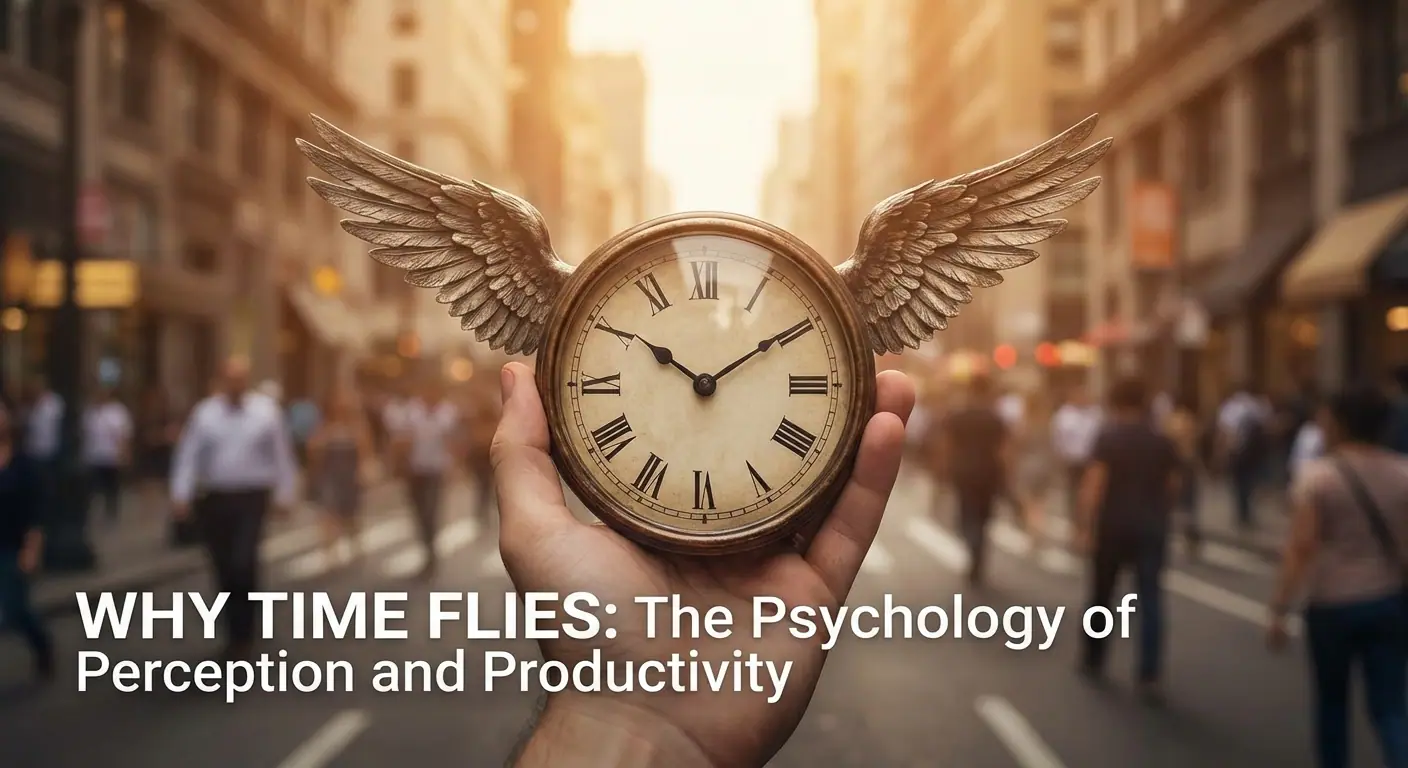
We have all felt it. You glance at the clock, dive into a project you love, and when you look up again, three hours have vanished. Conversely, we’ve all stood in line at the DMV, watching the second hand on the wall clock tick... so... slowly... that it seems to be moving backward.
Physically, a second is always 9,192,631,770 oscillations of a caesium atom. But mentally? Time is elastic.
The Dopamine Connection
Neuroscience suggests that our perception of time is heavily linked to dopamine, the neurotransmitter associated with pleasure and reward. When you are having fun, your brain releases more dopamine. This state of engagement suppresses your brain's internal "clock checking" mechanism.
Essentially, your brain is so busy processing the enjoyment of the moment that it forgets to log the passage of time. This is the phenomenon known as "Time Flies When You're Having Fun."
The "Flow State" vs. The Clock
Psychologist Mihaly Csikszentmihalyi coined the term "Flow State" to describe a zone of immense focus where self-consciousness falls away and time distorts. For developers, writers, and artists, this is the Holy Grail of productivity.
However, getting into Flow is hard when you are constantly interrupted. This is why "Time Blocking" works so well. By dedicating a set window (e.g., 2 hours) to a single task and turning off notifications, you give your brain permission to stop monitoring the clock and enter Flow.
Why Time Speeds Up as We Age
Have you noticed that summers felt endless when you were a child, but now entire years seem to blur by? There is a mathematical reason for this.
When you are 5 years old, one year represents 20% of your entire life. It is a massive chunk of your experience. When you are 50, one year is just 2% of your life.
Furthermore, our brains encode time based on new experiences. Childhood is full of "firsts"—first day of school, first bike ride, first kiss. These novel data points make time feel dense and long. As adults, routine takes over. If you drive the same commute every day for 10 years, your brain stops recording the details, compressing those memories and making the years feel shorter.
How to Slow Down Time
If you want to live a "longer" life (perceptually), the answer isn't to watch the clock—it's to break the routine.
- Travel to a new place: Even a weekend trip to a new city can feel like a week because of the density of new information.
- Learn a new skill: The frustration of learning forces your brain to pay attention, slowing down your internal clock.
- Practice Mindfulness: Being present in the moment creates more memory markers, expanding your perception of the day.
Frequently Asked Questions
Q: Why does time seem to speed up as we get older?
A: This is known as the "Proportional Theory." As we age, each year becomes a smaller percentage of our total life lived. Additionally, our brains compress routine memories, making repetitive years feel shorter than novel childhood years.
Q: What is the "Flow State" in psychology?
A: Flow is a mental state of complete immersion in an activity. During flow, the brain reduces activity in the prefrontal cortex (responsible for self-monitoring), causing us to lose track of time and perform at peak productivity.
Q: Can we mentally slow down time?
A: Yes. By seeking out new experiences, learning new skills, and practicing mindfulness, we force our brains to record more detailed memories. This density of new information makes the passage of time feel slower and richer in retrospect.