
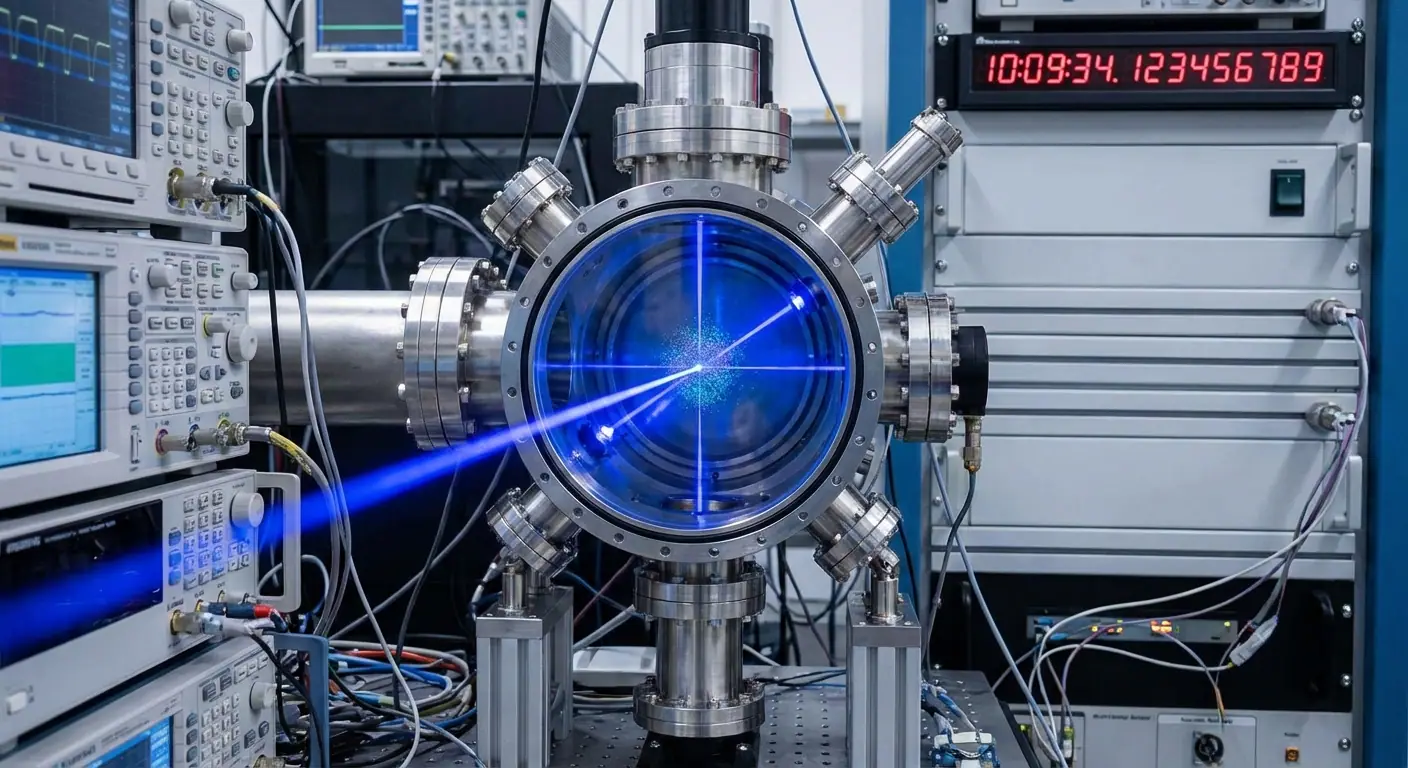
In our modern digital world, "time" is not just a concept—it is the invisible heartbeat of the global economy. From the GPS navigation in your car to the high-frequency stock trading algorithms on Wall Street, virtually every modern technology depends on Atomic Time.
But how do we actually define a second? And how does that precise definition travel from a laboratory in Germany to the smartphone in your pocket?
The Redefinition of the Second
For centuries, a "second" was simply defined as a fraction of a day (1/86,400th of a rotation of the Earth). The problem? The Earth is a terrible timekeeper. Tides, earthquakes, and atmospheric drag make the Earth's rotation irregular and gradually slower.
To solve this, scientists turned to quantum mechanics. Unlike a quartz watch which counts the mechanical vibrations of a crystal, an atomic clock measures the resonance frequency of atoms. Most primary standards use Caesium-133 atoms. When exposed to specific microwaves, these atoms oscillate between energy states at an incredibly specific frequency.
In 1967, the second was officially redefined: "The duration of 9,192,631,770 periods of the radiation corresponding to the transition between the two hyperfine levels of the ground state of the caesium-133 atom."
This frequency is so stable that a high-quality atomic clock will not lose or gain a second in over 100 million years.
The Hierarchy of Time: Understanding Stratum Levels
You can't fit a caesium fountain clock inside your laptop. Instead, the world uses a hierarchy of time servers known as the Network Time Protocol (NTP) to distribute time.
- Stratum 0: These are the actual atomic clocks (like those at PTB in Germany, NIST in the USA, or on GPS satellites). They are the source of truth. You cannot connect to them directly over the internet.
- Stratum 1: These are computers directly connected to Stratum 0 devices via dedicated cables. They are the "primary time servers."
- Stratum 2: These servers sync with Stratum 1 servers and distribute time to the public or other organizations.
iTime.live bridges this gap. When you visit iTime.live, the browser checks a Cloudflare edge-time endpoint and estimates network latency. The resulting display is intended for everyday clock checks and scheduling, not scientific or financial timing.
TAI vs. UTC: The Leap Second Problem
There are actually two "true" times. International Atomic Time (TAI) is the pure count of atomic seconds. It never stops, never slows down.
However, because the Earth's rotation is slowing down, TAI eventually drifts away from the solar day (when the sun is overhead). To fix this, we use Coordinated Universal Time (UTC). UTC is based on atomic time but occasionally adds a "Leap Second" to keep our clocks in sync with the Earth's rotation.
Why Precision Matters
Why do we go through all this trouble for a few nanoseconds?
- GPS Satellites: GPS works by measuring how long a signal takes to travel from a satellite to your phone. Light travels 300 meters in 1 microsecond. A clock error of just 1 millisecond would put your location off by 300 kilometers!
- Financial Markets: Automated trading algorithms execute millions of trades per second. If clocks aren't synchronized, a trade could appear to happen before the order was placed, causing chaos in the ledger.
- Power Grids: Electricity is generated in phases (AC). Managing the flow of power across a continent requires the grid to be synchronized within microseconds to prevent massive blackouts.
- Internet Security: Protocols like SSL/TLS rely on accurate timestamps to validate security certificates. If your clock is wrong, secure websites will fail to load to protect you from replay attacks.
Frequently Asked Questions
Q: What is the most accurate clock in the world?
A: While commercial atomic clocks use Caesium, experimental "Optical Lattice Clocks" using Strontium or Ytterbium atoms are so precise they wouldn't lose a second in 15 billion years (longer than the age of the universe).
Q: How does my computer connect to an atomic clock?
A: Your computer uses NTP (Network Time Protocol) to ping a Stratum 2 server. It calculates the time it took for the message to travel (latency) and adjusts the timestamp it receives to account for that delay.
Q: Why does GPS require atomic clocks?
A: GPS satellites calculate position based on the time delay of radio signals. Since light travels extremely fast, an error of just 1 microsecond in the satellite's clock would result in a location error of roughly 300 meters on the ground.