
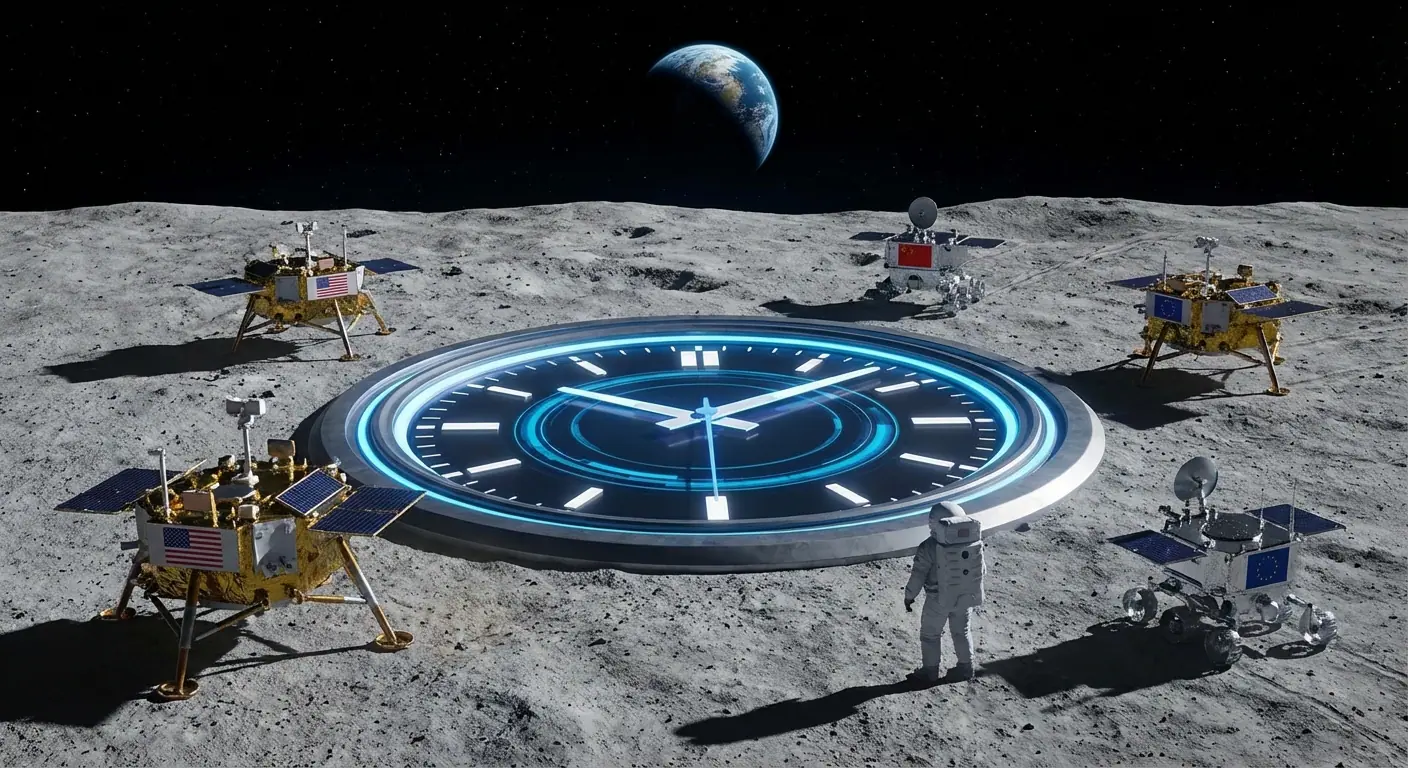
Here is a question that sounds like a joke but is actually a multi-billion dollar engineering problem: What time is it on the Moon?
For decades, individual lunar missions just used the time zone of the country that sent them. An Apollo mission ran on Houston time. A Soviet rover ran on Moscow time. But as NASA prepares for the Artemis missions and the establishment of a permanent lunar base, this ad-hoc system is no longer sustainable.
The Problem: Relativity is Real
You might think we could just set a clock to UTC (Coordinated Universal Time) and put it on the Moon. Unfortunately, Albert Einstein has something to say about that.
According to the Theory of General Relativity, time moves differently depending on gravity. The Earth has a much stronger gravitational pull than the Moon. Because of this difference in gravity, time actually moves faster on the Moon compared to Earth.
How much faster? About 58.7 microseconds per day.
That might sound negligible to a human, but for computers, GPS navigation, and docking maneuvers, 58 microseconds is an eternity. If left uncorrected, that drift would cause navigation errors to accumulate, potentially causing a spacecraft to miss its landing zone by kilometers.
Enter LTC: Coordinated Lunar Time
To solve this, the White House has directed NASA, in coordination with the European Space Agency (ESA), to establish Coordinated Lunar Time (LTC) by the end of 2026.
LTC will not just be "UTC +/- hours." It will be a distinct time scale, maintained by a network of atomic clocks placed on the lunar surface and in lunar orbit. These clocks will "talk" to each other to create a reliable average, similar to how we calculate UTC on Earth, but adjusted for the Moon's specific gravitational environment.
The Solar System Internet
This isn't just about the Moon. It is the first step in building a "Solar System Internet" (LunaNet).
In the future, when humans travel to Mars, the time delay for a signal to return to Earth can be up to 20 minutes. A Mars astronaut cannot ask Houston what time it is—by the time the answer arrives, it's already old news.
By establishing LTC, humanity is creating the framework for independent timekeeping zones across the solar system. Just as iTime.live checks your browser against network time, future devices will synchronize to lunar or martian Stratum-0 servers.
Will Your Watch Have a Moon Dial?
Probably not anytime soon. But for the astronauts living on the Artemis base, their schedule won't be dictated by the sun rising and setting (a lunar day lasts 29.5 Earth days). They will live and work by the steady, relentless ticking of the LTC atomic pulse, marking humanity's first official step into becoming a multi-planetary species.
Frequently Asked Questions
Q: What time zone is used on the Moon currently?
A: Currently, there is no single time zone. Missions typically use the time zone of mission control on Earth (e.g., Houston time). However, NASA is developing Coordinated Lunar Time (LTC) to standardize this by 2026.
Q: Does time pass differently on the Moon?
A: Yes. Due to General Relativity and the Moon's weaker gravity, time moves slightly faster on the Moon—about 58.7 microseconds faster per day compared to Earth.
Q: Why can't we just use UTC on the Moon?
A: Over time, the 58-microsecond daily drift would desynchronize GPS and navigation systems. A distinct lunar time scale is needed to ensure safe precision landing and orbital docking maneuvers.